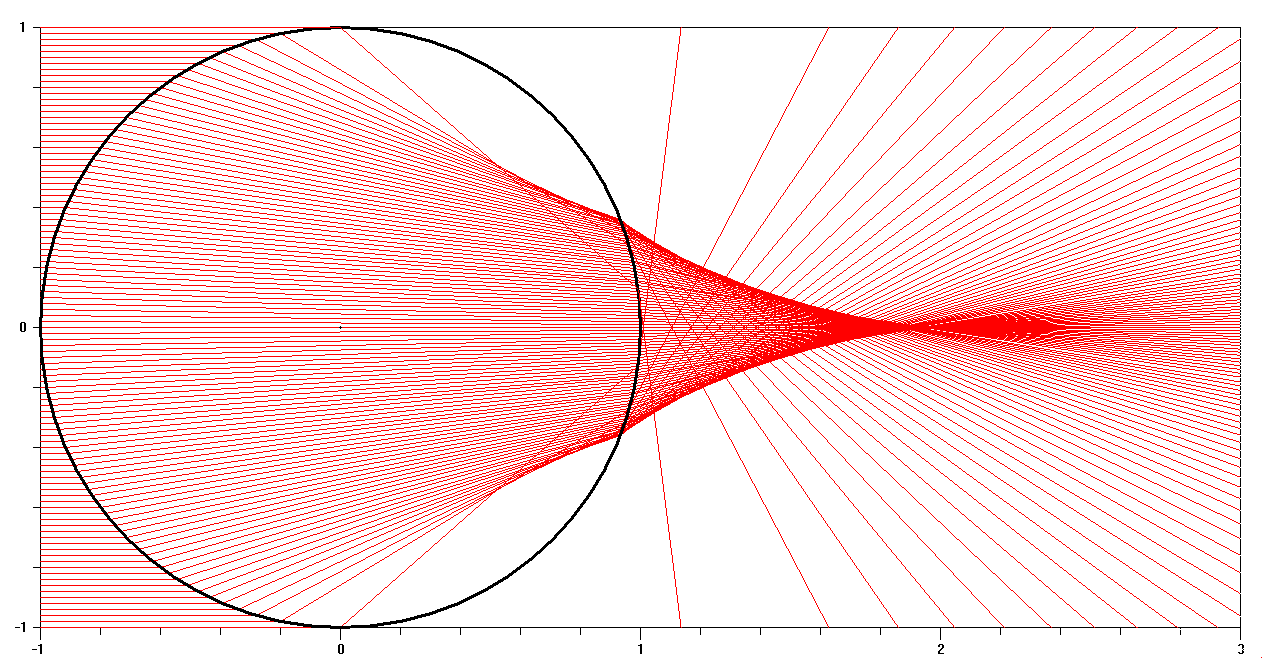
Fig. 1 Ray tracing for p = 1
| Previous page: Internal and near-fields |
The calculations of internal and near-fields shown on the previous page were based on a spherical particle with size parameter x = 2 π a / λ = 100 (where a is the radius of the particle and λ is the wavelength of the light) and refractive index n = 1.3333. Assuming red light with λ = 0.65 μm = 650 nm, this implies that the particle would have radius a ≈ 10.35 μm.
This page examines the effects of different size parameters (ranging from x = 10 to x = 1000) on internal and near fields.
Before showing the results of Mie theory calculations, it is probably helpful to examine ray paths calculated using geometrical optics, as shown below in Fig. 1 for p = 1, where the parallel incident rays on the left of the sphere are tracked as they pass through the sphere. Note that the maximum intensity in Fig. 1 corresponds to the convergence of p = 1 rays at x ≈ 1.9 and y = 0 to the right of the sphere.
Fig. 2 (a)-(g) below display Mie theory calculations to examine the effects of different size parameters, ranging from x = 10 to x = 1000. The circle in each diagram represents the spherical particle: the centre of the particle is at x0 = 0 and y0 = 0 with radius r = 1. The intensity of the field is represented by the false colour scale shown above each diagram: this scale is normalised to the maximum field in each diagram. Note that each diagram contains a black cross indicating the point of maximum intensity and that this point moves away from the sphere as the partcle size is increased.
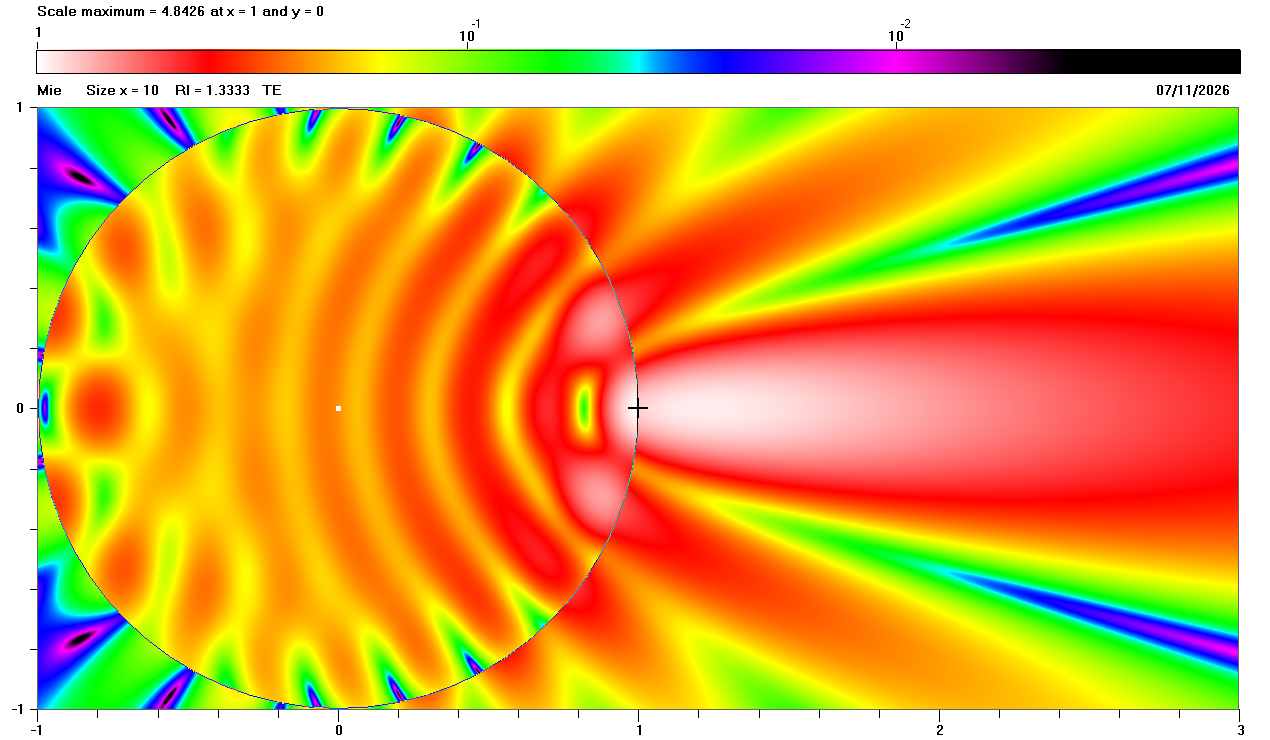
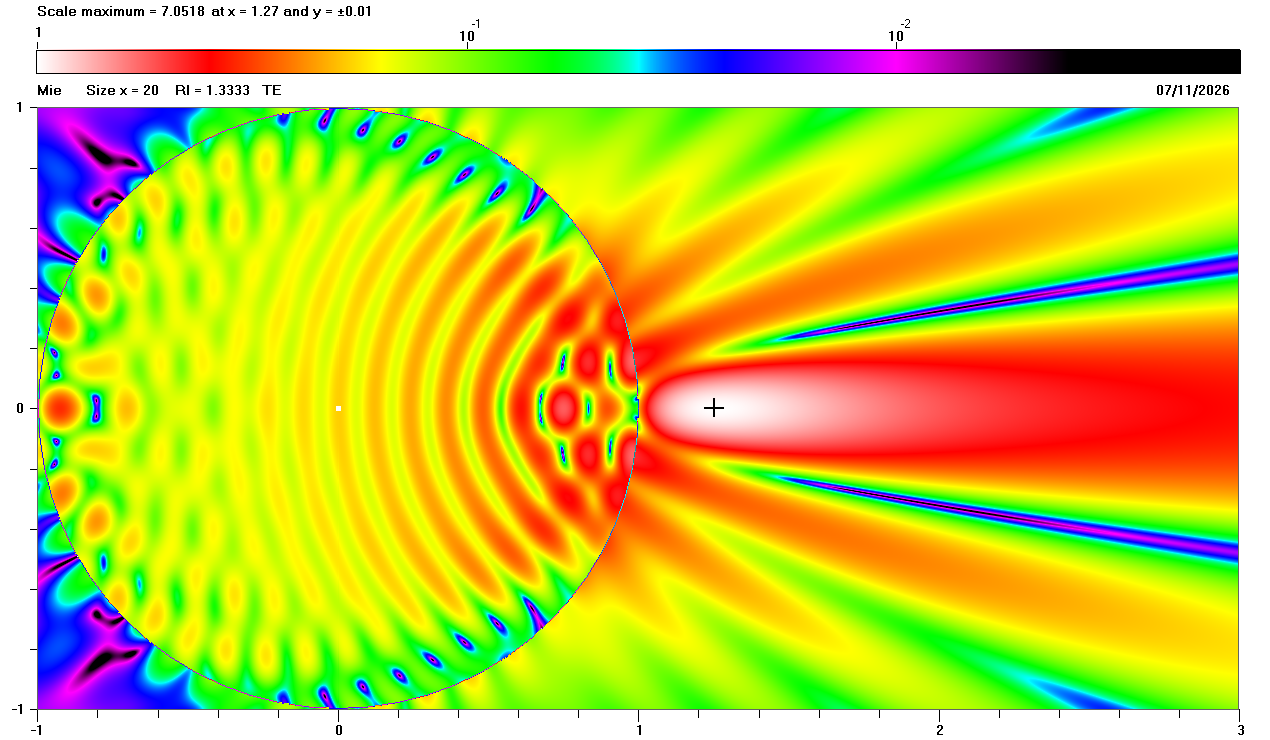
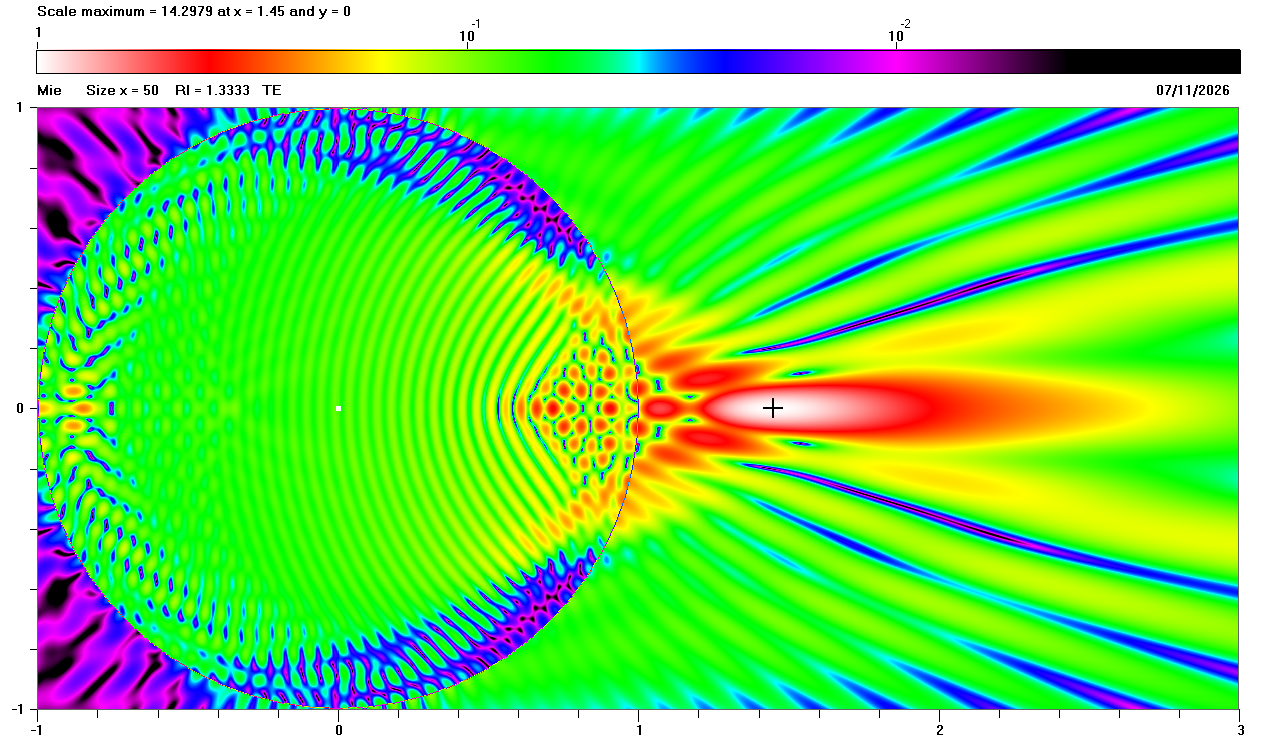
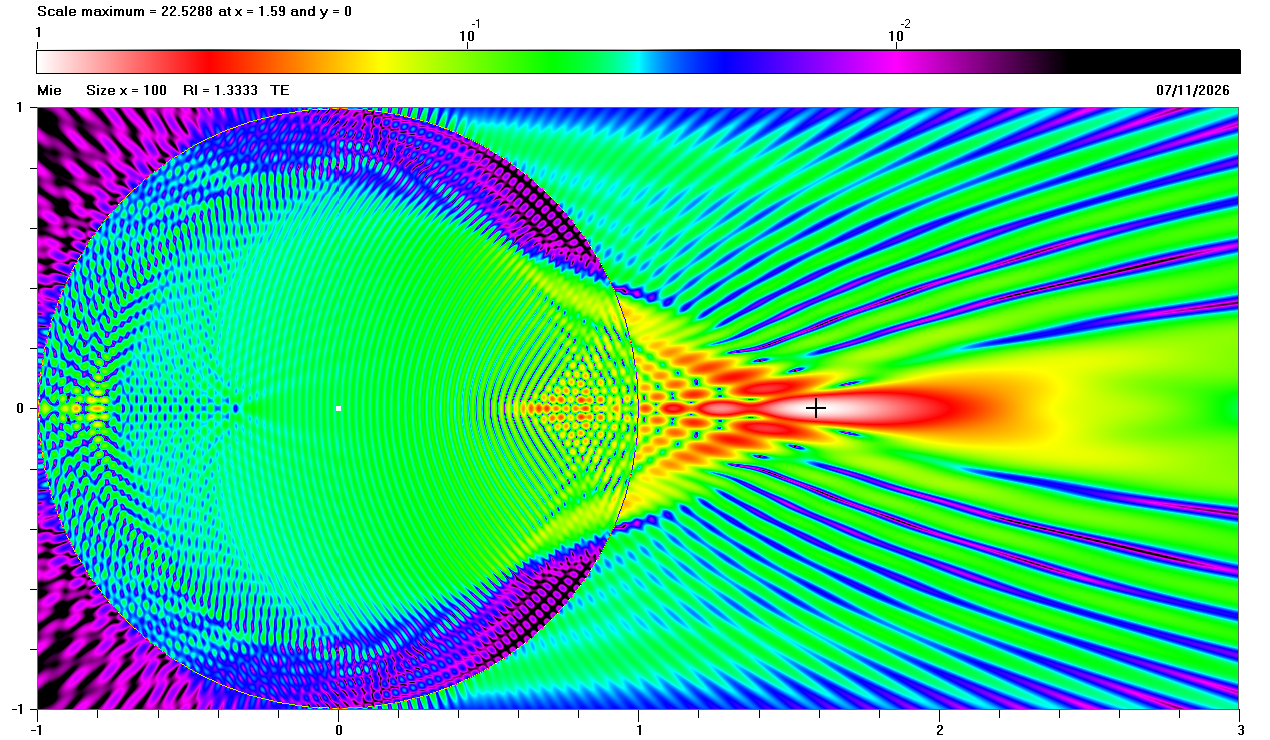
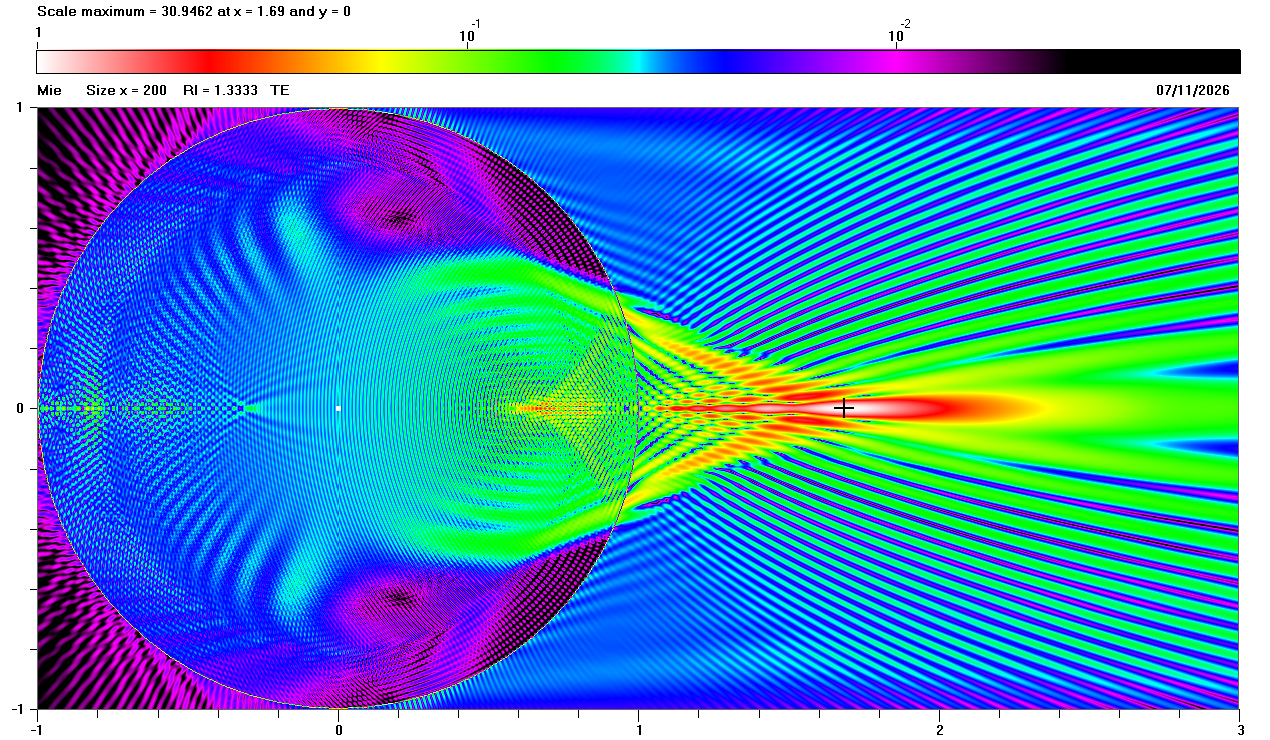
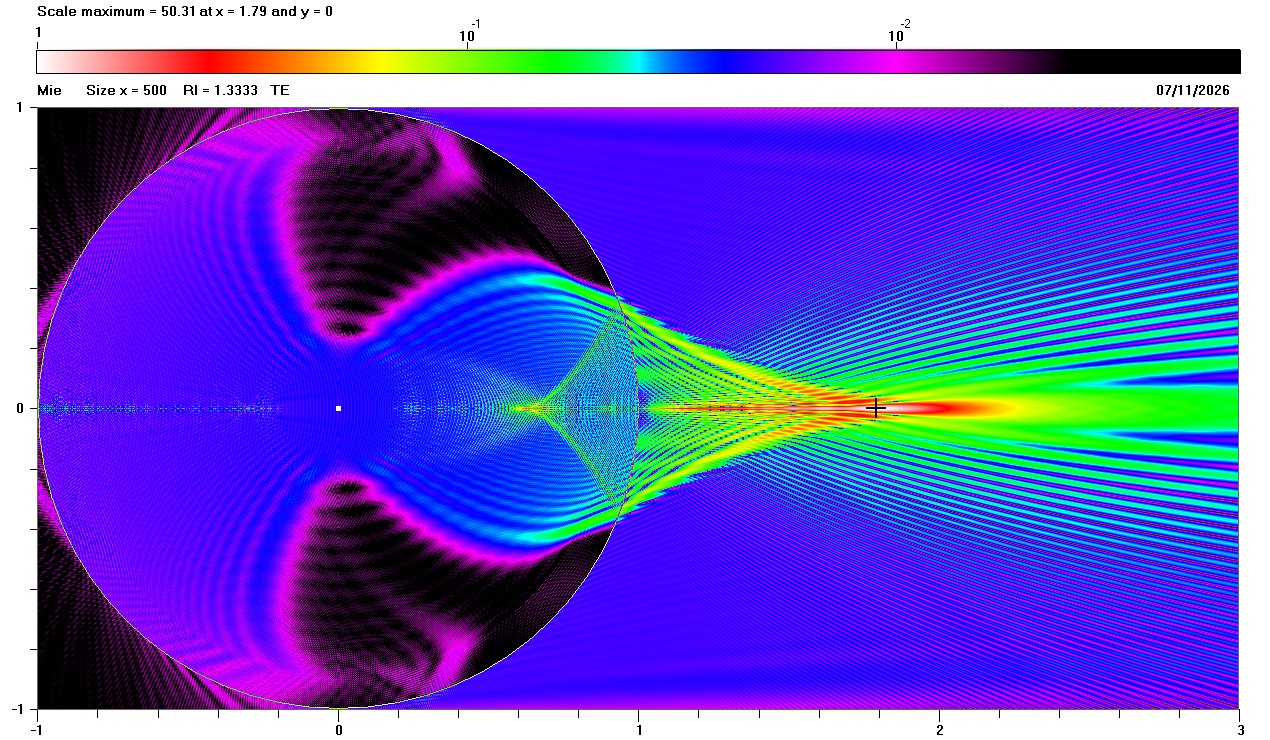
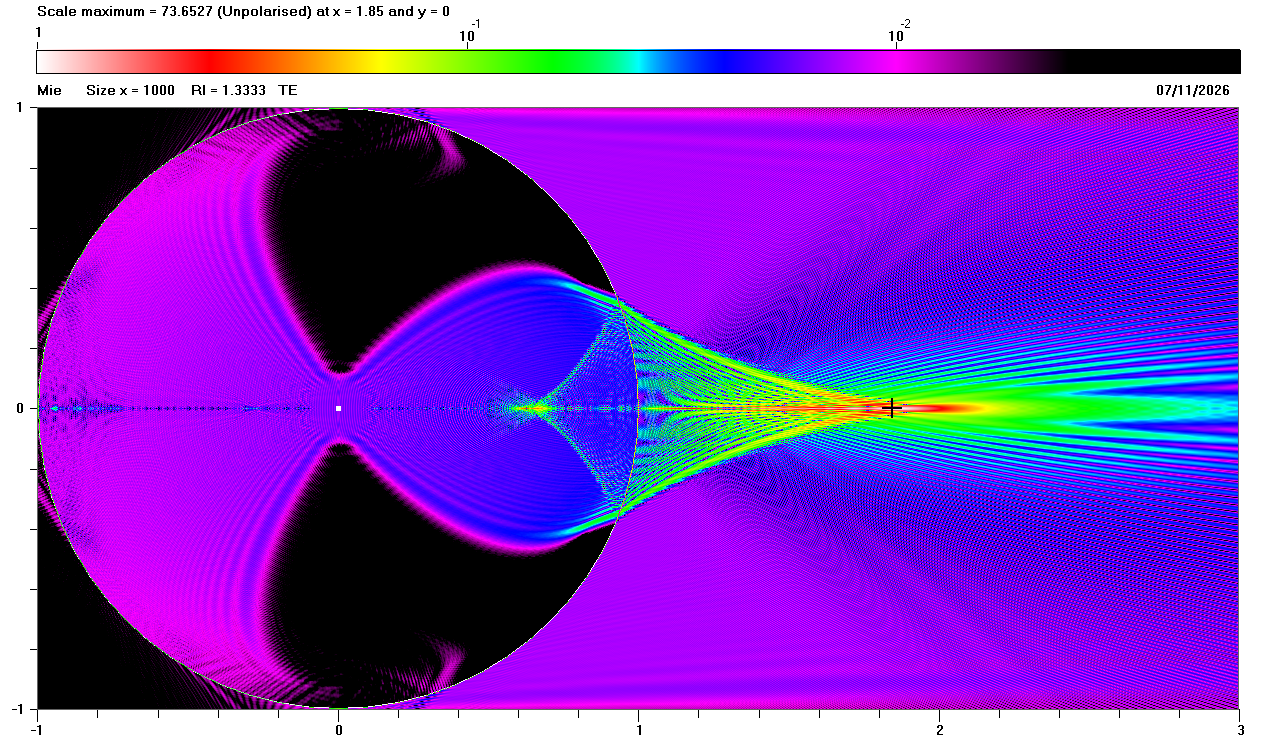
As indicated by the black crosses in each of the above diagrams, it is clear that position of the maxima depends on the particle size, as summarised in Table 1 below:
Given that, as shown by Fig. 1, ray tracing indicates that the point of convergence (and hence maximum intensity) occurs at x ≈ 1.9 and y = 0. As this result is very similar to the Mie result for size parameter x = 1000, it suggests that ray tracing is a good model of forward scattering for size parameter x > 1000. However, Mie theory and the Debye series are essential tools for accurate calculations of internal and near-field scattering.
| Previous page: Internal and near-fields |